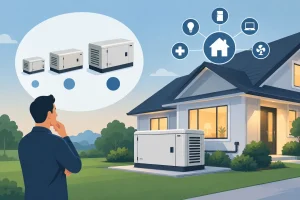
A Houston outage can turn from inconvenient to miserable quickly, especially when summer heat leaves your home without air conditioning. The right generator size for house backup power is not simply the biggest unit you can buy. It is the unit that safely supports the circuits and equipment your family needs, without overloading the generator or your electrical system.
For some households, that means keeping the refrigerator, lights, internet, and a few outlets running. For others, it means powering central AC, a well pump, medical equipment, or most of the home. A licensed electrician can help you make that decision based on your actual electrical loads, your panel capacity, and the way your home is wired.
Start With What You Need to Keep Running
The most useful way to choose a generator is to separate essential loads from convenience loads. During a short outage, many homeowners are comfortable running refrigeration, select lighting, a garage door opener, phone chargers, Wi-Fi, and a television. During a longer outage, the priorities usually grow to include cooling, cooking, laundry, a sump or well pump, security equipment, and medical devices.
Your home does not need to run every appliance at the same time to be comfortable. In fact, identifying priorities is often the best way to keep generator cost, fuel use, and installation requirements under control. A properly designed essential-load system can provide dependable backup power without requiring a whole-home generator.
Think through a realistic outage at your house. Which rooms must stay comfortable? Does anyone rely on powered medical equipment? Do you work from home? Is preserving refrigerated food a major concern? In the Houston area, central air conditioning is often the deciding load because it requires far more power than lights and electronics.
Common Home Generator Sizes and What They Can Handle
Generator output is measured in watts or kilowatts. One kilowatt equals 1,000 watts. While every home and appliance is different, these ranges offer a practical starting point.
A portable generator in the 3,000- to 5,000-watt range can often support a refrigerator, a freezer, lights, internet equipment, chargers, and a few small appliances. It is a limited backup solution, but it can protect the basics during a brief outage.
A 7,500- to 10,000-watt generator can typically handle a larger group of essential circuits. Depending on the equipment, that may include refrigeration, lighting, outlets, a microwave, a garage door opener, and one smaller air-conditioning solution. It may also be suitable for selected 240-volt equipment, but load management still matters.
A 12,000- to 16,000-watt system is often considered for homes that want broader coverage, including more kitchen circuits, multiple refrigerators, a well pump, or a larger HVAC load. At this level, professional planning becomes especially valuable because starting loads and panel configuration can change the real-world result.
Whole-home standby generators commonly begin around 18 kW and can extend well above 24 kW, depending on the home. These systems are permanently installed, connected through an automatic transfer switch, and usually fueled by natural gas or propane. They are designed to start automatically when utility power fails and can be sized to run most or all household loads.
These examples are not a substitute for a load calculation. A 2,000-square-foot home with a gas furnace and one efficient AC system may need a very different generator than a similar-size home with electric heat, a pool pump, two HVAC units, and an electric range.
Generator Size for House: Running Watts vs. Starting Watts
Every generator decision needs to account for two types of electrical demand. Running watts are the power an appliance needs while operating normally. Starting watts, sometimes called surge watts, are the temporary extra power needed when motors start.
Refrigerators, freezers, air conditioners, pumps, and many power tools have motors. A refrigerator may use a modest amount of power while running, then require a substantially higher surge when its compressor starts. An air-conditioning compressor can create an even larger starting demand.
This is why adding the wattage printed on a few appliance labels does not always produce an accurate generator size. If several motor-driven appliances start at the same time, a generator that looked large enough on paper can trip, stall, or fail to carry the load.
Modern HVAC equipment can vary widely as well. A variable-speed system may have different operating characteristics than an older single-stage system. Some homes benefit from load-management controls or a soft-start device for an AC compressor. Those options can sometimes reduce generator demand, but they must be evaluated and installed correctly.
How to Estimate Your Backup Power Needs
Begin by making a list of the equipment you want available during an outage. Find the running wattage and starting wattage from manufacturer labels, manuals, or professional testing. Then add the running loads that may operate together, along with the largest expected starting load.
As a broad reference, LED lighting uses relatively little power, while a refrigerator, microwave, electric water heater, electric dryer, range, pool pump, and central AC can change the calculation significantly. Heating elements are particularly demanding. An electric range or water heater may consume thousands of watts on its own, and running both with AC can push a system well beyond a basic generator’s capacity.
Build in room for normal changes in use. A generator that operates at its limit may struggle when another appliance turns on or when an engine loses output in extreme heat. Choosing a system with reasonable capacity helps protect performance and gives your household more flexibility during a prolonged outage.
A professional load calculation is the safer choice when you want central AC, 240-volt appliances, automatic operation, or broad whole-home coverage. It also helps avoid paying for more generator than your household actually needs.
Portable vs. Standby Generators
A portable generator can be a practical option for basic, occasional backup power. It costs less upfront and can be used for other purposes, but it requires manual setup, fuel storage, safe outdoor placement, and careful connection to the home. It should never run in a garage, carport, enclosed patio, or near doors, windows, or vents. Carbon monoxide is a serious hazard.
A standby generator offers a more complete solution. It sits outside like an AC unit, monitors utility power, starts automatically, and transfers power to designated circuits or the whole home through approved equipment. For homeowners who travel, have health-related power needs, or want cooling protection during severe weather, automatic backup can provide meaningful peace of mind.
The trade-off is cost and installation scope. A standby system may require a gas assessment, electrical panel work, transfer equipment, permits, placement planning, and coordination with local code requirements. The result should be a system designed for your home, not a generator selected from a generic chart.
Do Not Connect a Generator Directly to an Outlet
Using a cord to feed a generator into a household outlet, sometimes called backfeeding, is dangerous and illegal. It can energize utility lines, putting neighbors and utility workers at risk. It can also damage appliances, overload wiring, and create fire hazards.
A safe installation uses an approved transfer switch or interlock system installed by a qualified electrician. This equipment isolates the home from the utility supply before generator power is introduced. It also makes it clear which circuits the generator can serve and helps prevent accidental overloads.
For portable generators, an electrician can install a properly rated power inlet and transfer equipment so you can connect the generator from a safe outdoor location. For standby units, the electrical connection, automatic transfer switch, grounding, and load controls all need to be matched to the generator and the home.
Factors Houston Homeowners Should Not Overlook
Houston-area weather affects generator planning. High temperatures increase the value of cooling, and hurricanes or severe storms can create outages that last longer than expected. Natural gas standby generators avoid the need to refill gasoline cans, but fuel availability, gas-line capacity, and local conditions still need to be reviewed.
Your electrical panel matters, too. An older or crowded panel may need an upgrade before it can safely support a generator connection. If you are adding an EV charger, renovating, upgrading HVAC equipment, or planning a pool, consider those future loads now. Coordinating projects can prevent costly rework later.
Noise, placement, maintenance access, and neighborhood rules also deserve attention. Generators need adequate clearance, stable mounting, ventilation, and regular maintenance. A backup-power system that is not tested and serviced may not perform when you need it most.
Spring Electric & A/C can assess your priorities, calculate the loads that matter, and help plan a code-compliant generator installation for your home. The goal is dependable power without guesswork, unsafe connections, or unnecessary expense.
When you are ready to plan backup power, start with the next outage you can realistically picture. A clear list of what your family needs to keep running gives your electrician the information needed to build a safer, more useful solution.


Leave a Reply