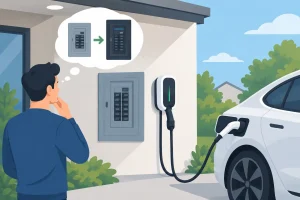
A Level 2 EV charger can make daily driving much easier, but it also adds one of the largest continuous electrical loads in many homes. If you are asking, “do I need a panel upgrade for EV charger installation?” the answer depends on more than the number printed on your breaker panel. Your home’s total electrical demand, the condition of the equipment, available breaker space, and your charging goals all matter.
For Houston-area homeowners, air conditioning is a major part of the equation. A home that handles normal lighting and appliances without trouble may be working much harder on a hot Texas afternoon when the AC is running. Adding EV charging safely starts with an accurate assessment, not a guess based on whether there appears to be an open breaker slot.
Do I Need a Panel Upgrade for an EV Charger?
Not always. Many homes can support a Level 2 charger without replacing the main electrical panel, especially if the home has a modern 200-amp service, properly sized wiring, and enough calculated capacity. But some homes need a panel upgrade, a service upgrade, or another solution before a charger can be installed safely and to code.
A Level 1 charger plugs into a standard 120-volt outlet and draws relatively little power, though charging is slow. A Level 2 charger uses a dedicated 240-volt circuit and commonly delivers 32 to 48 amps of charging power. Because EV charging can run for several hours at a time, electrical code treats it as a continuous load. That means the circuit and service must be sized with extra capacity in mind.
For example, a 40-amp charging circuit is generally intended to supply a charger that draws up to 32 amps continuously. A 60-amp circuit may support a 48-amp charger, provided the vehicle, charger, wiring, panel, and electrical service are all designed for it. Installing the largest charger available is not automatically the right move. The best setup balances overnight charging needs with what your home can safely support.
Why an Open Breaker Space Is Not Enough
An empty space in the panel only tells you that there may be room for another breaker. It does not prove the panel has enough electrical capacity for the added load.
A qualified electrician performs a load calculation that accounts for the home’s existing electrical demands. This includes major appliances such as the air conditioner, electric range, dryer, water heater, pool equipment, well pump, hot tub, and electric heat. The calculation also considers square footage, general lighting and receptacle loads, and the rating of the main service.
This is especially important in homes with central air conditioning. During peak summer weather, your cooling system may already be one of the biggest electrical loads in the house. If the panel is overloaded, breakers may trip, equipment may not operate reliably, and electrical components can experience unnecessary stress. A panel upgrade is not simply about convenience. It is about protecting the home’s electrical system and the equipment connected to it.
Signs Your Home May Need Electrical Work First
Older homes are more likely to need improvements before adding EV charging, but age alone does not decide it. Some older homes have been upgraded over time, while newer homes may already have a full panel because of additions, pools, workshops, or high-demand appliances.
A professional evaluation is a smart next step when you have a 100-amp service, a crowded breaker panel, outdated equipment, or signs of electrical problems. Pay attention if breakers trip regularly, lights dim when larger appliances start, the panel feels warm, or you see corrosion, damaged breakers, or loose-looking wiring. These conditions deserve prompt attention whether or not you are planning to purchase an EV.
You may also need an upgrade if the panel uses discontinued or unsafe equipment, has no available breaker spaces, or cannot accept the properly sized breaker your charger requires. In some cases, a subpanel can provide additional circuit space. However, a subpanel does not create more service capacity. The load calculation still determines whether the existing service can handle charging.
Panel Upgrade vs. Service Upgrade: What Is the Difference?
These terms are often used interchangeably, but they can describe different work.
A panel upgrade typically means replacing an older, damaged, undersized, or overcrowded breaker panel with a newer panel. It may improve safety, provide more breaker spaces, and make room for future circuits. If the existing service capacity is adequate, the utility connection and service conductors may not need to change.
A service upgrade increases the amount of power available to the home, such as moving from a 100-amp service to a 200-amp service. This work can involve a new panel, meter equipment, service entrance wiring, grounding updates, and coordination with the utility. It is a larger project, but it can be the right long-term choice for a household adding EV charging, a generator, electric appliances, a pool, or a home addition.
The practical question is not whether your panel looks old. It is whether the existing system has the capacity, space, condition, and code-compliant equipment required for the charger you plan to install.
Your Charger Choice Can Change the Answer
You do not always need a 48-amp charger to enjoy reliable home charging. Many drivers travel well under 100 miles per day and can fully recharge overnight with a lower-amperage Level 2 charger. Choosing a 16-, 24-, or 32-amp unit may reduce the electrical demand enough to avoid a major upgrade in some homes.
That trade-off is worth discussing before installation. A lower charging rate can be a practical, safe option if your vehicle is parked overnight and your daily mileage is moderate. On the other hand, a higher-capacity circuit may make sense for a household with multiple EVs, long commutes, limited charging hours, or plans to add another electric vehicle later.
Smart load-management equipment may also be an option for certain homes. These systems can monitor household demand and reduce or pause vehicle charging when other loads are high. They must be selected and installed correctly, and they are not a substitute for correcting unsafe or inadequate electrical equipment. Still, they can be useful where a full service upgrade is not the best immediate fit.
What a Safe EV Charger Assessment Includes
A proper site visit should look beyond the garage wall. The electrician should inspect the main panel and service rating, review the condition of breakers and wiring, identify major loads, and determine the best route for the new circuit. The charger location matters because a long wire run, detached garage, outdoor installation, or difficult attic access can affect the scope of work.
The assessment should also address permits and local code requirements. EV chargers need a dedicated circuit, correct wire sizing, appropriate overcurrent protection, and proper grounding and bonding. Depending on the equipment and local requirements, additional protection may be needed. Permitted work and inspection help verify that the installation is safe, protects your home, and supports the charger’s manufacturer requirements.
If an upgrade is recommended, ask why. A clear explanation should identify whether the concern is insufficient electrical capacity, a lack of physical breaker space, outdated panel equipment, wiring condition, or a combination of factors. This gives you a useful plan instead of a vague recommendation.
Plan for the Rest of Your Home, Too
An EV charger is often the project that reveals a home is ready for electrical modernization. If you are also considering a standby generator, a new air-conditioning system, an electric water heater, an induction range, or a workshop circuit, planning those needs together can prevent repeat work later.
A 200-amp service may offer useful flexibility for many homes, but it is not automatically necessary for every EV owner. The right answer comes from your home’s actual load calculation and your plans for the next several years. A smaller, well-designed charging setup may be the most cost-effective choice now. A larger upgrade may be the better value if it prepares the home for several upcoming improvements.
Spring Electric & A/C can evaluate your electrical panel, charging needs, and major household loads before installation. A straightforward assessment helps you choose the right charger capacity, address safety concerns, and move forward with dependable power for the road ahead.


Leave a Reply